Down to the Sea by Bruce Henderson
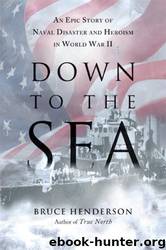
Author:Bruce Henderson
Language: eng
Format: epub
Publisher: HarperCollins
Fourteen
First word that Monaghan was in trouble on the morning of December 18 came at 9:27 A.M. in a message from the ship’s new captain, Bruce Garrett, with a total command experience of less than three weeks.
“I am unable to come to base course,” Garrett radioed fueling group commander Captain Jasper Acuff aboard his flagship Aylwin, a Farragut-class destroyer commanded by Lieutenant Commander William K. Rogers, one of Garrett’s four Annapolis classmates (1938) who had recently joined Destroyer Squadron One within weeks of one another. With the storm having thrown Monaghan off the assigned southerly course of 180 degrees, Garrett reported they were going in nearly the opposite direction on a “heading of 330 degrees.” Acuff feared the wayward destroyer was in danger of colliding with ships of another fueling unit 3,000 yards to the northwest. He knew that several ships in the northern unit, “caught in similar circumstances,” had “given up trying to maintain station” or stay in formation, and sans radar were “manned by blind men.”
Acuff ’s fleet fueling group was divided into three units, each made up of approximately the same composition of four oilers, one light aircraft carrier and escorting vessels. Monaghan was in the center group, with Hull in the northern group and Spence in the southern group.
Acuff stepped to the TBS. “Use more speed,” he told Garrett.
A few minutes later, Garrett reported: “Have tried full speed but it will not work.” After a brief pause, he said in a louder but still calm voice: “Cannot get out.”
On Aylwin, which was rolling violently in the heavy seas and experiencing steering difficulties of her own, Acuff and Rogers took Garrett’s message to mean the typhoon “had the helm” of his ship, which doubtless had fallen into a deep trough and was now “out of control.”
The last message from Monaghan was about 10:00 A.M., when Garrett came back on the TBS to warn an unidentified ship, “You are 1,200 yards off my port quarter. Am dead in water. Sheer off if possible.”
After that, Monaghan fell silent.
Aboard Monaghan, which lost TBS communication shortly after Garrett’s final message, things were anything but quiet, as the destroyer was “slammed back and forth between rumbling winds and booming waves.” At 10:30 A.M., with his ship in “grave jeopardy” after losing her main generator and steering motor, Garrett decided to take on ballast.
Joe “Mother” McCrane, the New Jersey native who had been aboard ship more than two years and was now a water tender 2nd class, had sounded the fuel tanks as part of making out the morning fuel report. He had reported the ship’s fuel state as “between 122,000 and 130,000 gallons” at 8:00 A.M.—about 70 percent of total capacity. This placed Monaghan above the established minimum of 45 percent fuel capacity set by the Bureau of Ships for Farragut-class destroyers, below which ballasting would have been required. Even so, McCrane thought “putting on ballast” would help the laboring ship, which he had noted with concern took longer to “come back
Download
This site does not store any files on its server. We only index and link to content provided by other sites. Please contact the content providers to delete copyright contents if any and email us, we'll remove relevant links or contents immediately.
| Africa | Americas |
| Arctic & Antarctica | Asia |
| Australia & Oceania | Europe |
| Middle East | Russia |
| United States | World |
| Ancient Civilizations | Military |
| Historical Study & Educational Resources |
The Radium Girls by Kate Moore(12033)
100 Deadly Skills by Clint Emerson(4929)
Rise and Kill First by Ronen Bergman(4792)
The Templars by Dan Jones(4690)
The Doomsday Machine by Daniel Ellsberg(4492)
The Rape of Nanking by Iris Chang(4218)
Killing England by Bill O'Reilly(4006)
Stalin by Stephen Kotkin(3971)
Hitler in Los Angeles by Steven J. Ross(3947)
12 Strong by Doug Stanton(3553)
Hitler's Monsters by Eric Kurlander(3346)
Blood and Sand by Alex Von Tunzelmann(3206)
The Code Book by Simon Singh(3194)
Darkest Hour by Anthony McCarten(3134)
The Art of War Visualized by Jessica Hagy(3012)
Hitler's Flying Saucers: A Guide to German Flying Discs of the Second World War by Stevens Henry(2757)
Babylon's Ark by Lawrence Anthony(2684)
The Second World Wars by Victor Davis Hanson(2528)
Tobruk by Peter Fitzsimons(2520)
